
For Store Owners
Exclusivity Is Not Something Your Tools Should Take Away
· 5 min read

A jeweler we spoke with put it simply: "I spent fifteen years building my name. I am not going to hand it to a platform." That instinct is correct. For independent jewelry stores, your brand is not a logo on a sign. It is the reason customers drive past three other stores to get to yours.
When new technology enters the picture, the first question is rarely "what can it do?" It is "what will it cost me?" Not in dollars, but in control. Will my designs look like everyone else's? Will my customers see a tech company's name instead of mine? Will I lose the thing that makes my store different? These are not hypothetical worries. Technology adoption in the jewelry industry has historically been slow for exactly this reason. Jewelers held off on CAD for nearly a decade before it became standard, and the hesitation around AI tools follows the same pattern.
Why Do Jewelers Resist Digital Design Tools?
Independent jewelers resist digital tools because most platforms are built for volume, not for individual store identity. They aggregate listings, apply shared branding, and position the platform as the destination. The jeweler becomes a supplier in someone else's marketplace, not the brand the customer came for.
This is not an irrational fear. Roughly 80% of the jewelry market is still composed of small independent retailers and unbranded suppliers. These stores compete on reputation, personal service, and the feeling that you are buying from someone who knows your name. A platform that flattens all of that into a uniform interface is a real threat to what makes them viable.
The broader luxury market reflects this tension. Bain & Company's 2024 luxury report found that the luxury sector lost approximately 50 million customers between 2022 and 2024. One reason: top customers are losing the feeling of exclusivity from the brands they buy from. If large luxury houses are struggling with this, independent jewelers are right to guard it carefully.

Is AI Making Jewelry Design Generic?
AI-generated jewelry designs can become generic when the tools are not built for the industry. General-purpose image generators produce attractive pictures, but they lack the constraints that make a design producible, priced correctly, or aligned with a store's style. GIA's Fall 2024 report on AI in jewelry design raised this directly, noting that AI-generated work "may lack the nuanced touch and emotional connection that is often conveyed through a human designer's work" and warning of "a homogenization of design styles."
That is a real risk when the AI operates without any store-level context. But it is not inevitable. The difference is whether the tool treats every store the same or lets each store define its own boundaries. We wrote about why general-purpose tools fall short in our post on why ChatGPT is not a jewelry platform, and the same logic applies to image generators like Midjourney.
The question is not whether AI can help with custom design. It can. The question is whether the jeweler stays in charge of what gets shown and how it gets presented.
What Does Brand Control Actually Look Like?
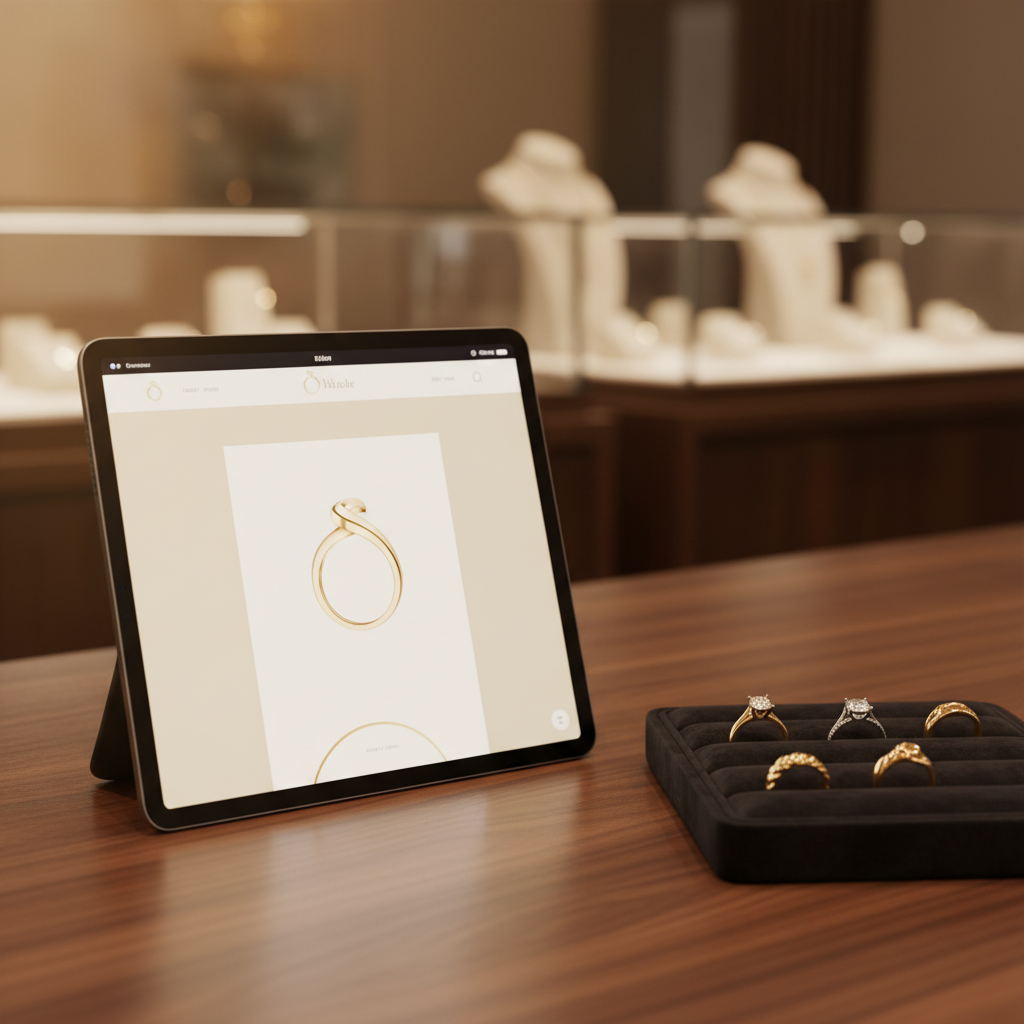
Brand control means more than putting your logo on a page. It means deciding who sees your store, what they can do there, and how your work is represented. On Diamra, your storefront does not have to be public. You can keep it private for in-store consultations only, share it with specific customers, or password-protect it for committed clients. This lets you use the platform as a high-end consultation tool rather than an open marketplace. We covered how this white-label model works in detail in our post on your name on the door, our tools in the back.
Every design generated in your store can carry your logo as a watermark. Your brand travels with every image, whether the customer screenshots it, shares it, or prints it. Your pricing, your markup, and your store identity stay front and center. There is no "powered by" badge and no competing branding. 70% of jewelry shoppers research purchases online before visiting a store, and when they land on your page, they should see your name and nothing else.
Your Designs Stay Yours
Designs generated in your Diamra store belong to you. They are not shared across other stores, reused in a public gallery, or fed into a model that trains on your output. Your customer data, your order history, and your workflow stay under your control. You can read the full details in the privacy policy. In an industry where digital advertising costs keep rising and customer acquisition gets harder every year, your existing relationships and original designs are what set you apart. A tool that siphons those off is not a tool. It is a competitor.
The point of adopting new technology is to do more of what already works, not to replace it with something generic. Your store should feel more intentional after adding a design tool, not less. You can add your store and try it yourself. See the pricing page for details.