For Store Owners
Why Most Custom Jewelry Inquiries Never Become Orders
· 5 min read
Custom jewelry is the most profitable category in a jewelry store. Margins on custom pieces run between 60% and 70%, well above what most ready-made inventory produces. And customer interest is not the problem. The global custom jewelry market is valued at $42.3 billion and growing at 16% annually.
Yet in most independent stores, custom stays a small share of total revenue. Not because customers do not want it. Because the process between "I have an idea" and "yes, make that" is where orders go to stall. We covered the time cost in our post on the real cost of custom jewelry design. This post looks at the pattern behind that stalling, and what it actually costs a store each year.
What Is the Custom Jewelry Friction Loop?
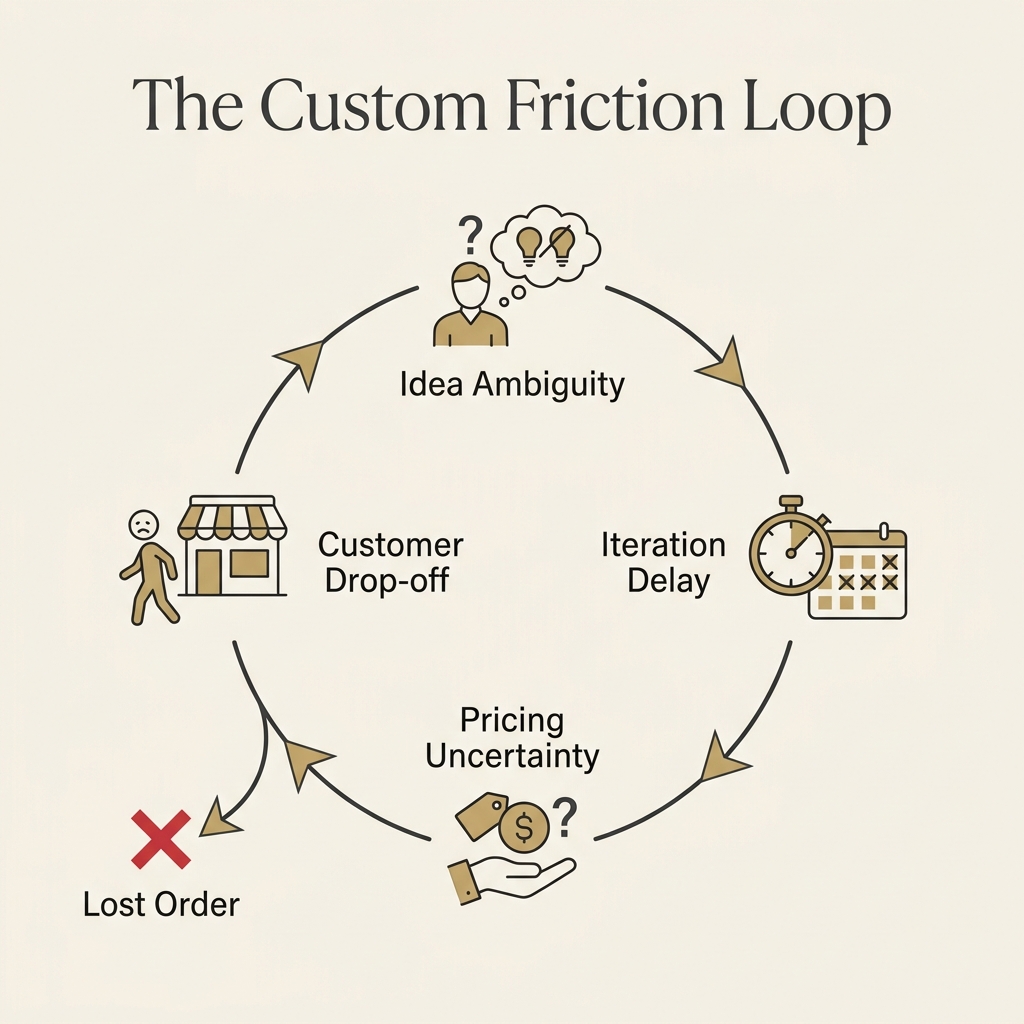
The friction loop is a four-stage cycle that most custom inquiries follow before failing to convert. It starts with idea ambiguity, moves through iteration delay and pricing uncertainty, and ends with customer drop-off. Each stage feeds the next, and the loop repeats until the customer loses momentum.
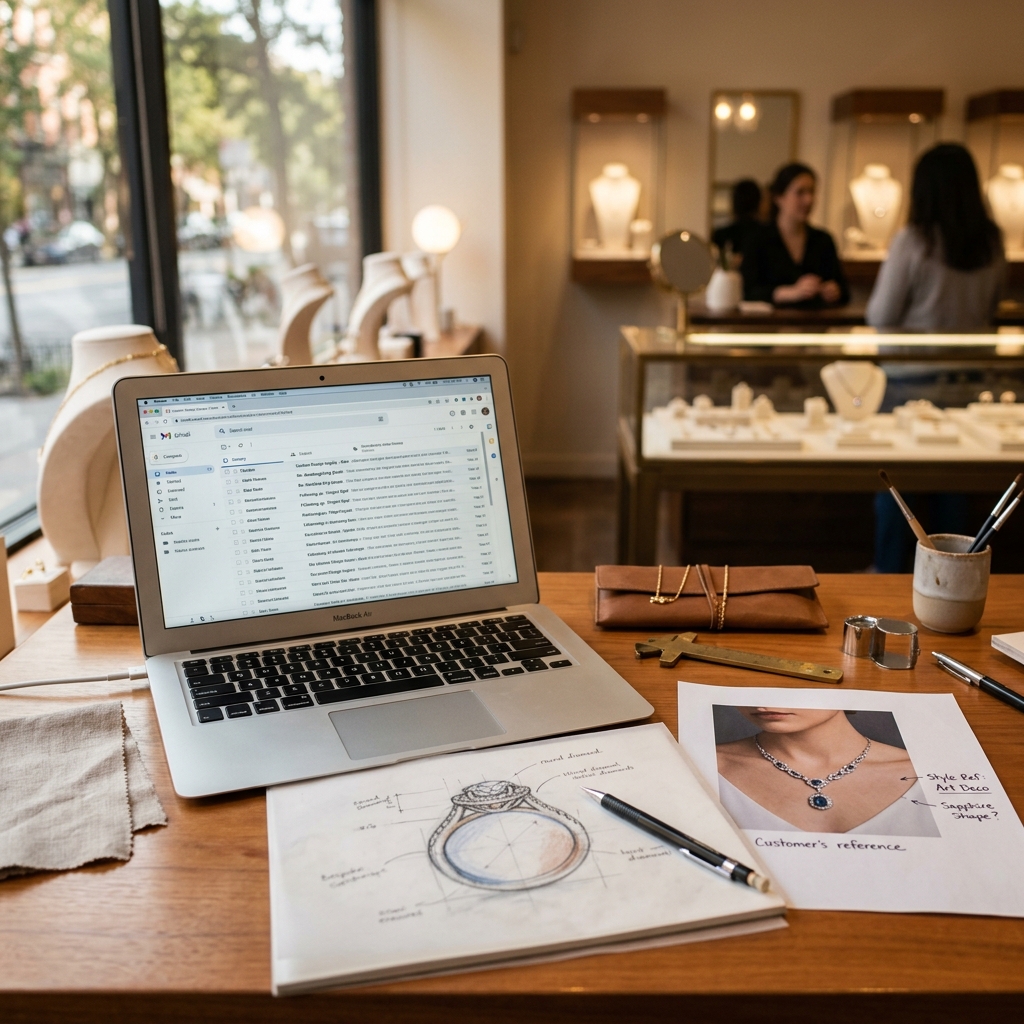
Stage one: the customer has a picture in their head but cannot describe it in clear visual terms. Words like "vintage" or "elegant" mean different things to different people. Stage two: the jeweler interprets those words into a sketch or CAD rendering, sends it back, and waits for feedback. Each revision takes days. The design phase alone takes one to two weeks out of a four-to-six-week process.
Stage three: pricing comes late. The customer finally sees a number after weeks of design work and reconsiders their choices, triggering more revisions. Stage four: momentum dies. The customer feels like they are being difficult, or they simply lose the emotional energy that drove the inquiry. They stop responding. The order never happens.
How Much Does This Friction Actually Cost?
A store receiving ten custom inquiries per month that loses 30% of them to process delays, at an average order value of $3,000, gives up roughly $9,000 in monthly revenue. Over a year, that is more than $100,000 in orders that never reached the bench.
The direct revenue loss is only part of it. Sales staff spend hours managing communication instead of closing. Designers and CAD specialists get pulled into repetitive revision cycles for orders that may never convert. Skilled bench workers sit idle waiting for finalized designs. About 70% of jewelry consumers research purchases online before visiting a store, and if that first interaction is a blank form and a long wait, the store loses before a conversation even starts.
None of this is a people problem. It is a system problem. We wrote about how this pattern plays out operationally in our post on faster custom jewelry workflows.
Why Is Fabrication Not the Bottleneck?
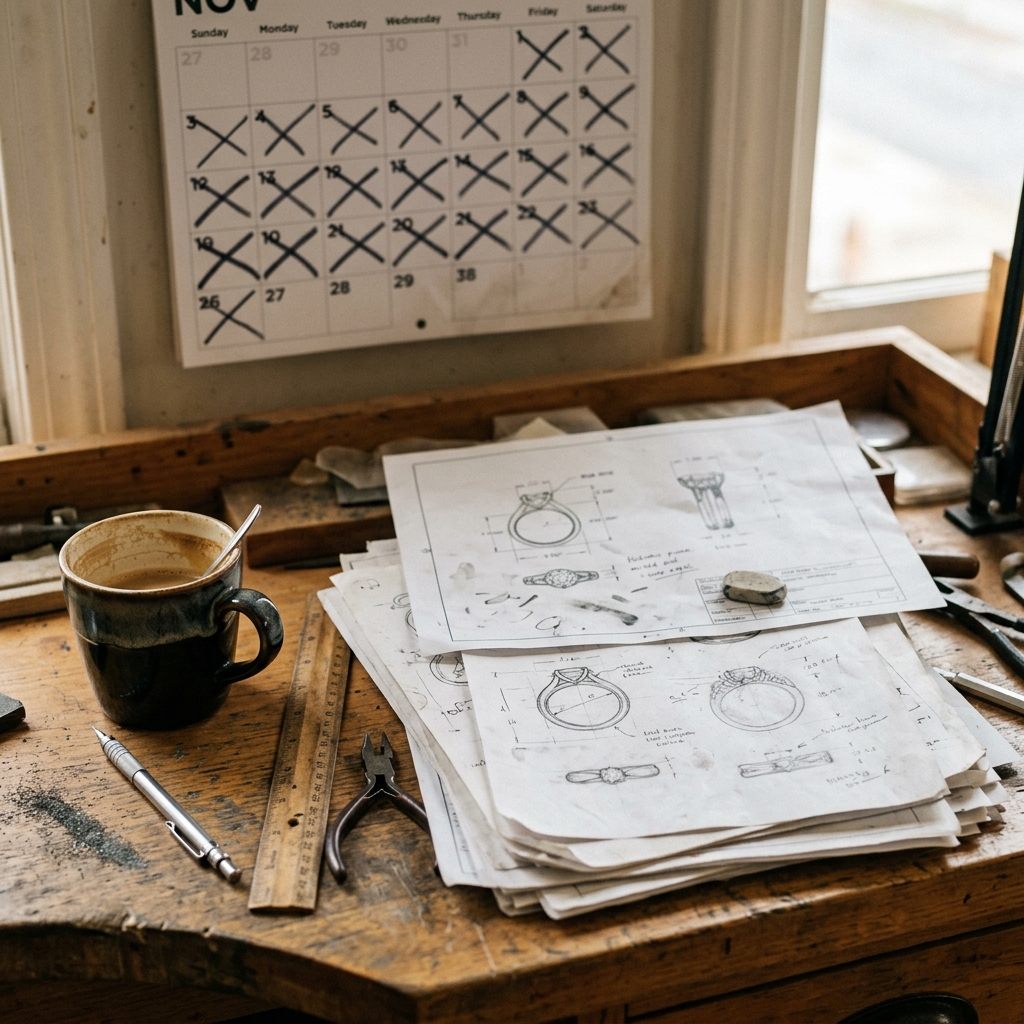
Fabrication, including casting, stone setting, and polishing, typically takes a few days to a couple of weeks. It is relatively predictable and efficient. The real bottleneck is everything that happens before the bench: interpreting unclear input, producing visual representations, and waiting between feedback cycles.
Moving from "I have an idea" to "yes, make this" routinely takes four to six weeks. Most of that time is not productive work. It is back-and-forth: emails, revised sketches, and waiting. AI tools cut design iteration time by a third in industries that have adopted them, and jewelry is no exception. The craft itself was never the slow part.
Roughly 80% of the jewelry market is independent retailers. These stores compete on personal service and reputation. They cannot afford to let their most profitable category stay bottlenecked by a process that was designed before digital tools existed.
What Breaks the Loop?
The loop breaks when the customer can see a design in real time instead of waiting days between each revision. A customer types "yellow gold ring, oval emerald, thin band" and sees a rendered image immediately. They adjust it on the spot. Pricing updates with every change, so there is no late-stage sticker shock. The alignment phase that used to take weeks happens in minutes.
When the order arrives, it comes with a clear image, a materials list, and a price the customer already agreed to. Your craftsmen start working instead of waiting. Your sales team closes instead of coordinating. 86% of buyers will pay more for a better experience, and speed is a major part of what "better" means.
Custom jewelry is not a design problem. It is a conversion problem. The friction loop is predictable, and it is fixable. You can see how it works on the pricing page, or add your store and try it yourself.