
For Store Owners
Best Jewelry CAD Software in 2026 (And When You Don't Need CAD)
· 7 min read
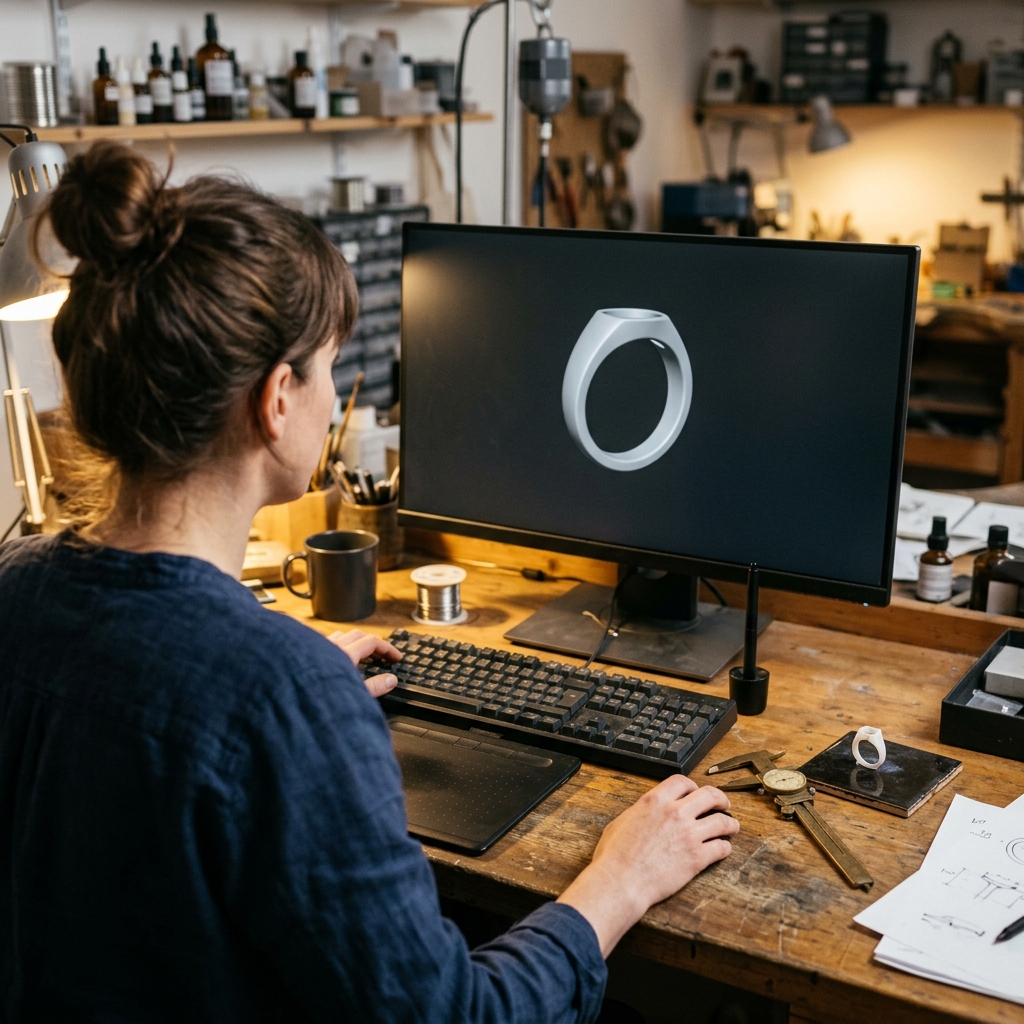
Search for the best jewelry CAD software and you get a list of products. That list answers the wrong question for most of the people asking it, because two very different people type that search: a designer who will spend the next five years in one program, and a store owner who just wants a customer to see their ring.
Those two need opposite things. This guide covers the real tools first, honestly, then the part the vendor pages skip: the cases where buying CAD is the most expensive way to solve your problem.
What Is the Best Jewelry CAD Software?
There is no single best jewelry CAD software, because professional studios run three to five programs per piece. Rhino with the MatrixGold plugin is the closest thing to an industry standard, 3Design leads in parametric work, JewelCAD Pro is strong on free-form organic shapes, ZBrush handles sculpted detail, and Blender is the free option.
The split follows the geometry. Precise, classical work (bands, solitaires, halos, signets) belongs in NURBS surfaces, which is Rhino's home ground, and MatrixGold adds jewelry builders on top of it: prong and bezel setting tools, pavé layout, a stone catalog. Naturalistic work (filigree, leaves, animal motifs) is faster to sculpt in ZBrush and then bring back into clean surfaces. A resizable family of rings across sizes and stones wants history-based parametrics, which is where 3Design earns its European following.
Two practical notes rarely mentioned in comparisons. Most jewelry CAD plugins run inside Rhino, so learning Rhino is the transferable skill and the plugin is the accelerator. And JewelCAD's dominance in Asian manufacturing means files often arrive in its format, which matters if you work with overseas production.
What Does Jewelry CAD Software Cost?
A Rhino 8 commercial license is $995 as a one-time purchase, or $195 for students and faculty. Jewelry-specific suites sit above that: MatrixGold is subscription-based, while 3Design and JewelCAD Pro sell perpetual licenses that run into the thousands. Blender costs nothing.
The license is the small number. The real cost is the learning curve: a working command of jewelry CAD takes months of daily practice, and the first year of models usually needs a bench jeweler to catch what will not cast. A store that buys software and assigns it to whoever has spare time typically ends up with an expensive unused seat.
That math is why the honest question is not which program to buy, but whether your store should be modeling at all. A store selling a few custom pieces a month rarely recovers the training time. A store with a designer on staff, or one doing volume custom work, clearly does.
When You Don't Need Jewelry CAD Software
Three common jobs get mistaken for CAD jobs. Showing a customer their idea is a visualization problem, not a modeling one. Getting one piece modeled for casting is a sourcing problem. Getting it made is a production problem. CAD software solves none of those three efficiently for a store that does not model daily.
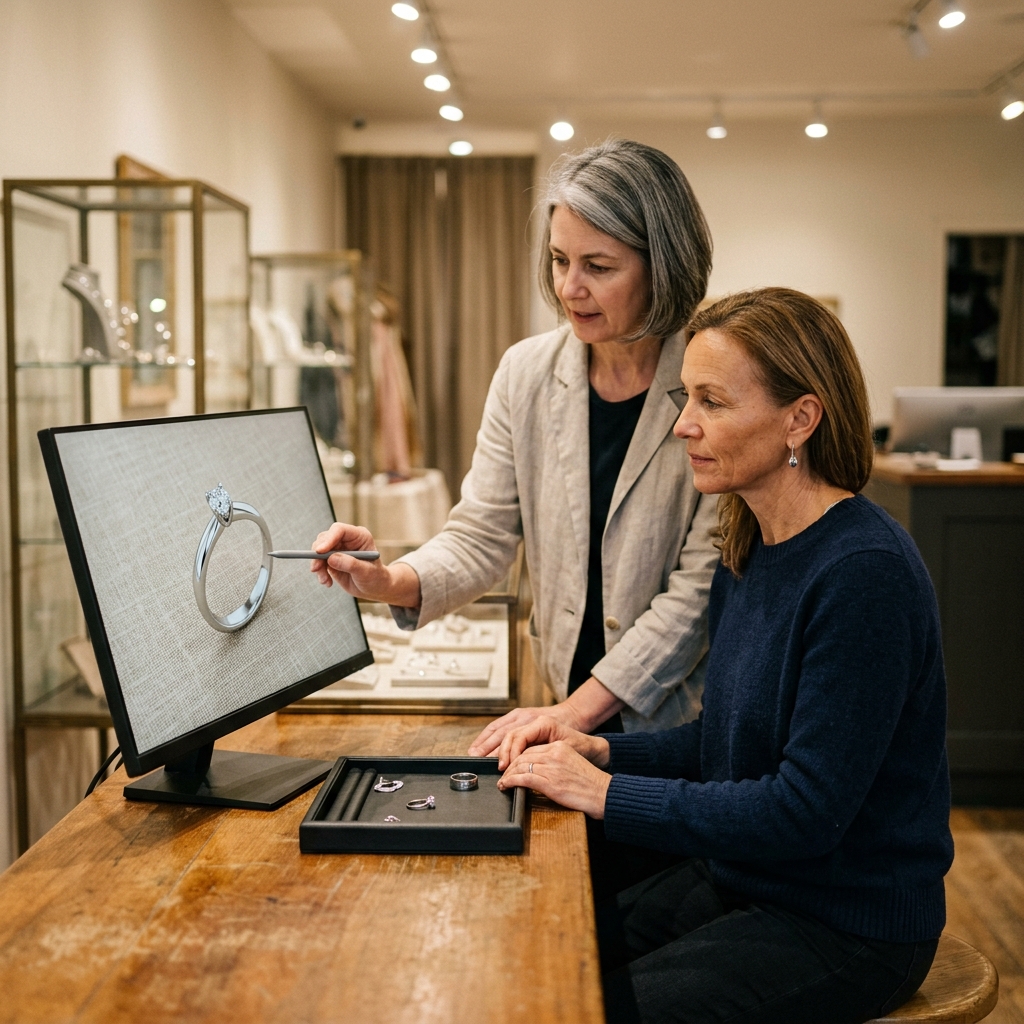
The first case is the most common and the most expensive to get wrong. A customer describing a ring needs to see something in the next few minutes, not next week. Jewelers already use AI tools for renders and visual work, and a design tool on your own site turns a description into a concept image while the customer is still in front of you. We covered the mechanics in how AI jewelry design works. It is not CAD, and for this job that is the point: nobody needs a manufacturable model to decide they love a design.
For the second and third cases, the work goes to people who already own the software and the skill. Independent CAD designers take a brief and return a production file, and manufacturers take that file and cast the piece. That is what our designer studio marketplace and production network exist for: a store sends a brief, gets quotes, and never buys a seat of anything.
How Should a Store or Designer Choose in 2026?
Choose by what you do every day. If you model daily, learn Rhino first and add MatrixGold when the builders start saving you real hours. If you sculpt organic work, pair Rhino with ZBrush. If you are testing whether you enjoy modeling at all, start with Blender and lose nothing but time. If you sell custom jewelry but do not model, skip CAD and buy the two things you actually lack: a way to show customers their piece, and a partner to model and make it.
The demand side rewards the second path more than it used to. De Beers' 2026 research found buyers increasingly want distinct pieces that feel personal, and retailers told JCK that custom work and experiences are carrying 2026. Meeting that demand is a sales-floor capability, and the modeling behind it can be bought by the piece.
Industry experts on a CIBJO panel told JCK they expect AI to reach everything from diamond grading to sales management, with one designer noting the technology handles deterministic, repetitive tasks well. Jewelry CAD has plenty of both, and the tools will keep absorbing them. What will not be automated is the judgment about whether a piece can be cast, set, and worn, which is why the people who know that are worth hiring whether or not you own their software. If you want the sales-floor half without the workstation, you can set up a store and see it working.